SWCS Southern New England Chapter 2026 Conference
SNEC Winter 2026 Conference is scheduled for Thursday, February 5th.

Recent SNEC conferences have focused on wetland restoration, water quality and solar energy. This year, the spotlight will be on soil and sediment – intact or disturbed, contaminated or pristine, surficial or otherwise. Time slots are typically 15-30 minutes plus Q&A; additional time could be allocated for group presentations or a panel discussion.
Valuable information and downloads.
Click the button below to view an archive of out past events.
Written by Robert Clinton on . Posted in Events, Uncategorized.

Written by Soil and Water Conservation Society Southern New England Chapter on . Posted in Current Fall, Events.
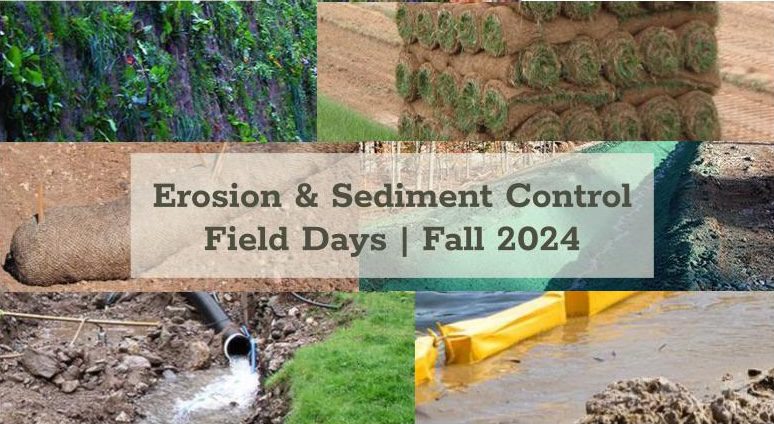
Soil moved by erosion can be harmful to our drinking water resources, fish and wildlife, and it can impact our quality of life. Erosion Control has changed dramatically over the years and new technologies are constantly in development. Use this workshop to help you stay current on useful practices and make valuable connections.
“A little bit of dirt never hurt anybody…” but a little bit from one jobsite multiplied by the hundreds of jobsites in a watershed can add up quickly. Soil erosion has the potential to affect how much treatment wastewater must receive. We all need to know our options for both controlling sediment and for designing and installing more effective long-term erosion control solutions.
These field days are a unique collaborative effort between the private and public sectors to share information and promote a better understanding of the latest tools available to all who are entrusted with protecting our precious soil and water resources.
SNEC Erosion and Sediment Control Field Days combine presentations and hands-on demonstrations. These days are training for professionals working in soils, erosion control, water quality, public works, engineering, roads, planning, resource protection, and consulting. Our goal is to provide information that is immediately useful to all who attend – you are encouraged to bring your site plans and questions!
Boxed lunch will be provided for the Field Days.
Field Days are hosted by SWCS SNEC, in partnership with EJ Prescott.


Westerly Education Center, Room 201
23 Friendship Street
Westerly, RI 02891
AGENDA
The morning session will be held at Westerly Education Center.
8:00 a.m. – Check-In and Coffee
8:30 a.m. – Welcome and Opening Remarks | Andrew Gorman (SWCS Southern New England Chapter RI Representative / Beals & Thomas)
8:45 a.m. – Forest Ecology and Ecosystem Health in Rhode Island’s Changing Forests | Fern Graves (R.I. Forest Stewardship Program Coordinator)
9:30 a.m. – Municipal Green Infrastructure | Doug McCluskey (EJ Prescott)
10:15 a.m. – Break and Networking
10:30 a.m. – Forestry BMP’s: Mitigating Sedimentation to Safeguard Riparian Species and Conserve Biological Diversity | Brooke Warrington (New England Forestry Foundation)
11:15 a.m. – RIPDES Stormwater General Permits | Brian Lafaille (P.E., RI DEM)
12:00 p.m. – Boxed Lunch and travel to Gingerella Sports Complex
12:45 p.m. – Rotation through Field Stations
3:45 p.m. – Closing Remarks
Tolland County Agricultural Center
24 Hyde Avenue (Rt. 30)
Vernon, CT 06066
AGENDA
8:00 a.m. – Check-in and Coffee
8:30 a.m. – Welcome and Opening Remarks | Alison Milliman (SWCS Southern New England Chapter CT Representative / BSC Group)
8:45 a.m. – Construction Compliance Inspections 101 | Alison Milliman (SWCS Southern New England Chapter CT Representative / BSC Group) and Matthew Capone (BSC Group)
9:30 a.m. – DEEP District Solar Inspection Partnership | Chris Stone (P.E., CT DEEP)
10:15 a.m. – Break and Networking
10:30 a.m. – CT Forestry Practices Act and BMP’s | Nick Zito (Forester, CT DEEP)
11:15 a.m. – Municipal Green Infrastructure | Doug McCluskey (EJ Prescott)
12:00 p.m. – Boxed Lunch
12:45 p.m. – Rotation through Field Stations
3:45 p.m. – Closing Remarks
Brigham Hill Community Farm
37 Wheeler Road
North Grafton, MA 01536
AGENDA
8:00 a.m. – Check-in and Coffee
8:30 a.m. – Welcome and Opening Remarks | Maggie Payne (SWCS Southern New England Chapter MA Representative / NRCS)
8:45 a.m. – Agriculture and the MA WPA | Mia McDonald (MassDEP Wetlands Circuit Rider Program Coordinator)
9:45 a.m. – Erosion Control? Consider the Soil! | Daniel Lenthall (Resource Conservationist, NRCS)
10:15 a.m. – Break and Networking
10:30 a.m. – Timber Harvesting, Erosion Control, BMP’s, and the Real World in Southern New England | Charlie Thompson (V.P., Massachusetts Forest Alliance)
11:15 a.m. – Erosion and Sediment Control: Considerations for Municipal Review | Matthew Cote, P.E., and Andrew Gorman, CESSWI/Beals and Thomas)
12:00 p.m. – Boxed Lunch
12:45 p.m. – Rotation through Field Stations
3:45 p.m. – Closing Remarks
JOIN the Soil & Water Conservation Society NOW
at the $115 Conservationist level and BENEFIT IMMEDIATELY
by registering at the $40 MEMBER RATE!
Simply select the Blue Light Special ticket – we’ll handle the paperwork.
This offer is for 1st-time SWCS members only.
NOTES:
Questions? Contact Us at info@swcssnec.org
Field Demonstration Questions: contact Doug at doug.mccluskey@ejprescott.com


Written by pwsbuilder on . Posted in Events, Uncategorized. 1 Comment on Friday March 16, 2018 – Winter Conference
Continuing Education Units!
The State of Connecticut has approved 2.5 CEUs for CT Certified Forest Practitioners!
Both the national Society of American Foresters (SAF) and state of Massachusetts have approved Continuing Education Units for attendance of this conference!
Lunch
CLICK HERE TO REGISTER FOR CONFERENCE
Healthy Forests Healthy Habitats Program.
$65 SWCS Members & SAF Members
$65 Government Staff
$90 Non-Members
$40 Students
Group Discounts (25% OFF)
Guest Speakers include;
Lois Bruinooge, Executive Director, The Last Green Valley & Coordinator, Southern New England Heritage Forest Project
“Partners Bring $6.1 Million to the Region for Forest Conservation!”
The Last Green Valley Presentation, CLICK HERE
Michael Downey, Service Forester, MA DCR
“Introduction to Agroforestry: The Science, Practice and Possibilities for Massachusetts” Agroforestry Presentation
Jennifer Fish, Service Forestry Program Director, MA DCR
“Foresters for the Birds Program” MA Audubon & DCR Foresters for the Birds Program
Fern Graves, Principal Forester & Stewardship Coordinator, RI DEM
“Healthy Forests” Healthy Forests Presentation
Douglas Hutcheson, Service Forester, MA DCR
“Forestry Best Management Practices” MA Forestry-BMP-Manual
Dr. Steve Johnson, Senior Ecologist, SWCA Environmental Consultants
“Rare and Endangered Species and Forest Cutting”
Christopher Martin, Forester, CT DEEP
“Forestry and Water Quality” CT Forestry & Water Quality BMP Presentation
John Scanlon, Habitat Program Supervisor, MA FWE
“MassWildlife Landscape Goals for Wildlife Habitats” MassWildlife Landscape Goals for Wildlife Habitats
Thomas E. Worthley, Associate Extension Professor, University of Connecticut
“Perspectives on Woodland Management in a Parcelizing World”
In keeping with the Forestry and Wildlife theme, we will be joined for the day by members of the Yankee Division of the Society of American Foresters (YDSAF), the professional forestry organization in Southern New England, for their Annual Meeting.
In conjunction with the conference, EnviroCert International, Inc. (ECI) will be leading review courses and a next day exam for several professional certifications including but not limited to the Certified Professional in Erosion & Sediment Control™ (CPESC®) and Certified Erosion, Sediment & Stormwater Inspector™ (CESSWI™) programs. Registration for these review courses and exams are available at http://booking.envirocertintl.org/ and is a separate registration.
Sponsors & Exhibitors
* BluRoc, LLC * National Grid * Eversource Energy *GZA GeoEnvironmental, Inc. *
* Stantec Consulting Services, Inc., * VHB * Fuss & O’Neill * BSC Group *
*Milone & MacBroom * Tighe & Bond *
* Bay State Forestry Service * Hull Forest Products *
* E. J. Prescott, Inc. * Filtrexx Northeast Systems *
* MA Department Conservation & Recreation (DCR) *
* The Last Green Valley * NRCS * MA Fisheries & Wildlife (FWE) *
* MA Forest Alliance * Mass Audubon * MA Woodlands Institute *


Written by Soil and Water Conservation Society Southern New England Chapter on . Posted in Current Fall, Events, Fall.
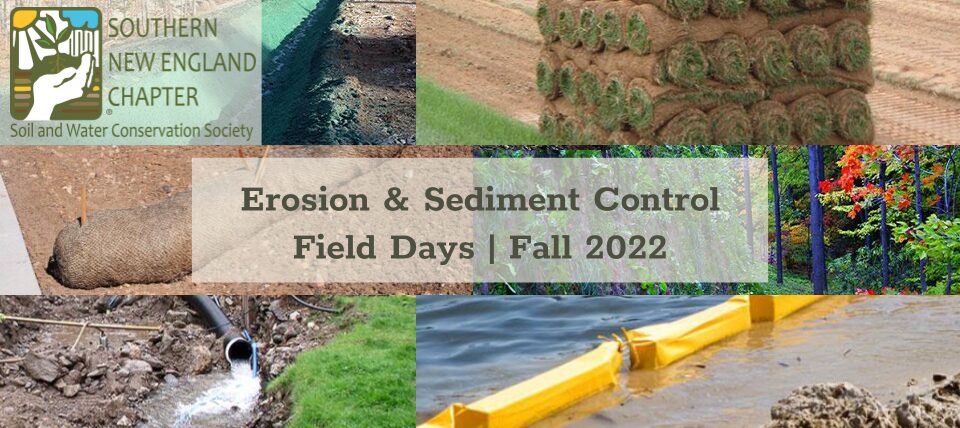
The Southern New England Chapter of the Soil and Water Conservation Society will host three days of our 2022 Erosion & Sediment Control Field Days:
Tuesday October 18, 2022 in Grafton, MA
(8am – 4pm)
Brigham Hill Community Farm| 128 Brigham Hill Rd, North Grafton, Massachusetts 01536
Wednesday, November 16 in Oakdale, CT (8am – 4pm)
Montville Community Center | 836 Old Colchester Rd, Oakdale, CT 06370
Phone: (860) 848-67804
Thursday, November 17 in Vernon, CT (8am – 4pm)
Tolland County Agricultural Center | 24 Hyde Avenue (Route 30), Vernon, CT 06066
Phone: (860) 875-5714
SNEC Erosion and Sediment Control Field Days combine presentations and hands-on demonstrations. These days are training for professionals working in soils, erosion control, water quality, public works, engineering, roads, planning, resource protection, and consulting. For registered attendees who attend full day, 6 hours of continuing education credits are available.
These events are a unique, collaborative effort between the private and public sectors to share information and promote a better understanding of the latest tools available to all who are entrusted with protecting our precious soil and water resources. Our goal is to provide information that is immediately useful to all who attend – you are encouraged to bring your site plans and questions!
Boxed lunch will be provided for the Field Days. Certificate of Attendance will be provided to document six (6) hours of educational contact.
Field Days are hosted by SWCS SNEC, in partnership with EJ Prescott.

Students must be currently enrolled full-time at an accredited high school, college, or university.
*Registration is required.
The same full-day training is offered at two locations. The program combines classroom presentations and hands-on field demonstrations, with small groups rotating through a series of stations. Our goal is to provide information that is immediately useful to all who attend. Demonstrations of the latest tools available regarding erosion and sediment control.
SPEAKERS
Tuesday, October 18th
Maggie Payne – Conservation Planner, Worcester County Conservation District, Soils and Soil Surveys
Sadie Constantine – Conservation Planner, Worcester County Conservation District, Conservation Planning Service
Brooke Washington – Climate Forestry Consultant, New England Forestry Foundation,Effects of Sedimentation and Forestry BMPs
Mia McDonald – Circuit Rider, MassDEP Wetlands Program, Low Impact Development Techniques
Doug McCluskey – Western Erosion Control & Stormwater Specialist, EJ Prescott, Low Impact Development and Green Infrastructure
Wednesday, November 16th
Montville Community Center | 836 Old Colchester Rd, Oakdale, CT 06370. Phone: (860) 848-67804
Chris Stone – Professional Engineer, Connecticut DEEP, Solar Field Erosion Impacts
Jean Pillo– Watershed Conservation Project Manager, Why We Need Stormwater Protection Plans,
Eric Dunnack – Forester, USDA Natural Resources Conservation Service, Connecticut Forest Practices Act and BMPs
Doug McCluskey – Western Erosion Control & Geoproduct Specialist, EJ Prescott
SPEAKERS
Thursday, November 17th
Tolland County Agricultural Center | 24 Hyde Avenue (Route 30), Vernon, CT 06066. Phone: (860) 875-5714
Chris Stone – Professional Engineer, Connecticut DEEP, Solar Field Erosion Impacts
Jean Pillo – Watershed Conservation Project Manager, Eastern Connecticut Conservation District Why We Need Stormwater Protection Plans, CPESC
Nick Zito – Forest Practices Act Forester, Connecticut DEEP, Connecticut Forest Practices Act and BMPs
Doug McCluskey, Western Erosion Control & Geoproduct Specialist, Everett J Prescott.
ACO: Stormbrixx GeoCellular Modular Stormwater Detention – Peter Shaw
Profile Products: Proganics Biotic Soil Media -Ashley Chong
Oldcastle Infrastructure: Manufactured Green Infrastructure Products – Brent Helm
Filtrexx: Grow Sock Applications – Jack Eaton
North American Green: Wattle Fence & Falcon Anchors – Rob Lawson
Concrete Canvas: Geosynthetic Cementitious Composite Mat Applications – Melanie Fuhrman
EJ Prescott: Permeable Interlocking Concrete Pavers – Mike Everhart
Approved by Envirocert International for 6 hours of professional development hours. These hours are applicable to professional certification renewals such as the Certified Professional in Erosion & Sediment Control (CPESC) certification.


Written by Soil and Water Conservation Society Southern New England Chapter on . Posted in Current Summer, Events, Summer.
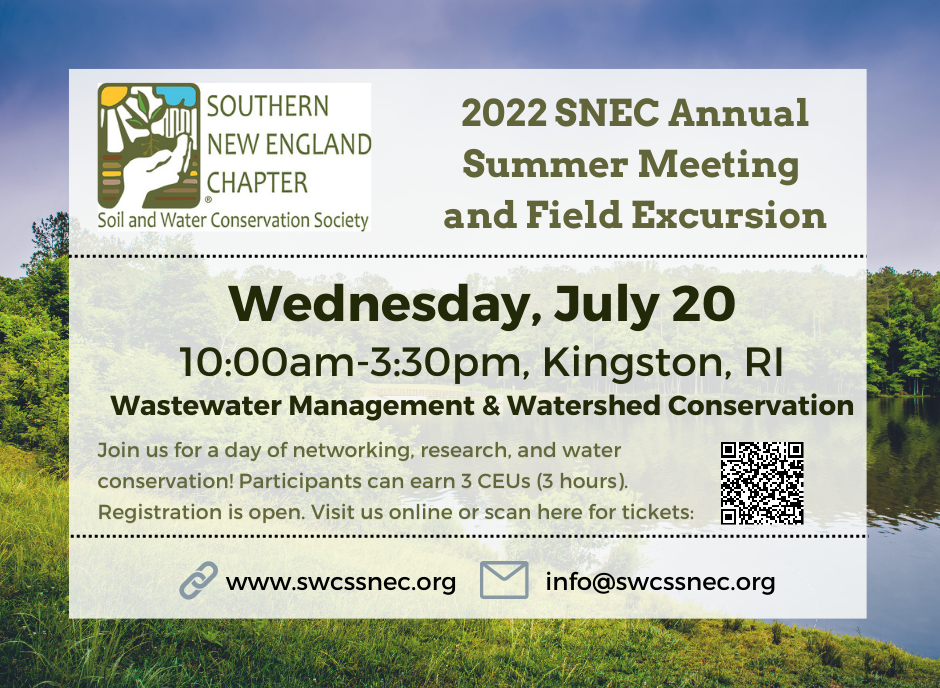
The Southern New England Chapter of the Soil and Water Conservation Society is hosting a field excursion on Wednesday, July 20 in Kingston, Rhode Island in collaboration with the URI Cooperative Extension. The event will begin with our SNEC Annual Meeting (open to all attendees, members and non-members) which is when we will announce the results of our 2022-23 Board of Directors Election, reflect on the past year, and discuss our goals for the future of the Chapter. Following this, we will hear from members of the University of Rhode Island Cooperative Extension, Alissa Cox and Elizabeth Herron. Elizabeth Herron is the Program Coordinator for URI’s Watershed Watch Program, Rhode Island’s largest volunteer water quality monitoring. She is actively involved in assessing water quality and watershed conditions throughout the state, including lakes, ponds, streams, salt ponds, and marine beaches.
Alissa Cox is the director of the New England Onsite Wastewater Training Program (NEOSTP). She earned her PhD in URI’s Laboratory of Soil Ecology and Microbiology (LSEM) and is a Clinical Assistant Professor in the Natural Resources Science department at URI. Alissa Cox will speak on the performance of different advanced treatment technologies and their effects on local water quality. After the presentations, attendees will participate in a guided tour of the Wastewater Treatment Center and Peckham Farm. After lunch, we’ll tour the onsite wastewater training center at Peckham Farm, where we’ll look at examples and explore the functions of different types of septic system technologies in our model systems. Afterward, we’ll go on a driving tour adapted from a tour developed by our partners at the Town of Charlestown to illustrate how advanced wastewater treatment matters, and what’s at stake.

Written by Soil and Water Conservation Society Southern New England Chapter on . Posted in Current Winter, Events, Winter.
Dr. Lal is an entrepreneur, a distinguished university professor, and a globally renowned soil scientist. Currently, Lal is the Director of the CFAES Rattan Lal Center for Carbon Management and Sequestration at the Ohio State University. Dr. Lal received the Glinka World Soil Price in 2018, the World Food Prize in 2020, the Good Will Ambassador of IICA in 2020, and the Padma Shri Award in 2021. His research interests are in regenerative agriculture, soil carbon sequestration, soil restoration, natural resource management, and global food security. President Biden appointed Lal as a Member of the Board for International Food and Agricultural Development in January 2022.
The World Food Prize writes, “Dr. Rattan Lal, a native of India and a citizen of the United States, wil I receive the 2020 World Food Prize for developing and mainstreaming a soilcentric approach to increasing food production that restores and conserves natural resources and mitigates climate change. Over his career spanning more than five decades and four continents, Dr. Lal has promoted innovative soil-saving techniques benefiting the livelihoods of more than 500 million smallholder farmers, improving the food and nutritional security of more than two billion people, and saving hundreds of millions of hectares of natural tropical ecosystems.”

Dr. Rattan Lal
For future generations, it is very important that soil resources must be protected, preserved, restored, and enhanced. That is where the future of humanity lies.

Beals + Thomas, Inc / sminihane@bealsandthomas.com
For future generations, it is very important that soil resources must be protected, preserved, restored, and enhanced. That is where the future of humanity lies.

Woodwell Climate Re search Center / hsullivan@woodwellclimate.org
Hillary received her B.S. in Environmental Science from Clark University,
and her M.S. in Biology also from Clark University. She has worked as a
research assistant studying nitrogen cycling in salt marshes for the past
seven years. In 2019, she started her PhD at Northeastern University studying
the effects of hydrology on salt marsh biogeochemistry.

BSC Group / gdavies@bscgroup.com / keithz@regenerativedesigngroup.com
Gillian Davies is a Senior Ecologist and registered Soil Scientist (SSSSNE) at BSC Group, focusing on climate change and wetlands and working with local communities to develop Nature-based Solutions, particularly wetland, forest, and soil conservation and restoration.

Keith Zaltzberg-Drezdahl is an environmental designer and founding principal of the Regenerative Design Group. He works with clients to create resilient and productive landscapes that contribute to human well-being and social justice, regenerate ecological vitality, and create beauty.
The Earth’s soil contains about twice as much carbon as is contained in the atmosphere and biosphere together. How we conserve and manage soils has a b ig impact on carbon emissions and withdrawals from the atmosphere. Wetland soils are particularly significant, as wetlands store approximately 30% of the world’s soil carbon, despite occupying only 5 – 8% of the earth ‘s land surface. Most of the carbon stored in wetlands is stored in the soil. This presentation will discuss three projects where soil conservation, restoration, and management for soil health were central elements. In one case study, a specific approach to conserving and translocating hydric soils from a wetland impact area to a wetland replication area will be discussed. In another case study, state climate resilience funding was used to implement a regional assessment and planning project that identified and prioritized Nature-based solutions focused on conserving and restoring wetlands, floodplains, forests, and other ecosystems that harbor significant soil and biomass carbon.

USDA/ kaitlin.farbotnik@usda.gov / joshua.beniston@usda.gov
Kaitlin Farbotnik is Kaitlin is the State Conservation Agronomist and Grazing Specialist for New Jersey NRCS. She has a B.S. in Agroecology with minors in Agricultural Entomology and Soil Science from the University of Wyoming. Kaitlin began her career with NRCS as a Conservation District intern writing HEL compliance plans in college.

Dr. Joshua Beniston is a Regional Soil Health Specialist for the Soil Health Division. Research and education in soil health have been Josh’s professional focus for the past 15 years. Josh earned an M.S. and Ph.D. in Soil Science at the Ohio State University. His research at Ohio State focused on soil carbon, soil health, and urban agriculture.
An abundance of vacant land exists in the formerly industrial cities of the U.S. Many communities have begun utilizing this land for functional greenspace and urban agriculture (UA) to improve the overall quality of life. This presentation will provide a summary of two projects that measured changes in soil carbon and health from management for UA. The first project focused on an experimental site located in vacant urban lots in Youngstown, OH where houses were recently demolished and removed and the soil was left in a degraded state. The experiment measured changes in soil properties and vegetable crop yields from applying organic amendments produced from urban green wastes. The second project was a field evaluation of soil health at nine urban market gardens in Ohio. Soil physical, chemical, and biological properties were measured and soil health was compared by calculating a soil quality index. These sites demonstrated h igh levels of both soil carbon and overall soil health. Observations from both projects indicate that management for UA can result in high quality soils. This presentation will a lso provide a short introduction to the NRCS Soil Health Division and our primary programs.

University of Nebraska / daiken@unl.edu
Professor Aiken joined the University of Nebraska Department of Agricultural Economics as a water and law specialist in 1975. A member of the Nebraska State Bar Association, Aiken has published over 100 technical and popular publications dealing with state water law, agricultural law, and more recently agricu ltural carbon credits.
Ag carbon cred its may provide a modest income stream to ag producers. The principal buyers are corporations who want to buy cheaper ag carbon credits instead of actually reducing corporate greenhouse gas emissions. But the market is an emerging one and f inding the r ight carbon program is challenging. Pending federal legislation would provide significant carbon market clarity but prospects for enactment are 50-50. If the US significantly regulated US greenhouse gas emissions, carbon cred it prices would likely increase, including prices for ag carbon credits. Forestry provides most of the US land-based carbon sequestration, which ag carbon credits are based on. Current US cropland carbon sequestration equals about 0.3% of current emissions, while grasslands equals about 0.2%.

United States Geological Survey / meagle@usgs.gov
Meagan Eagle is a Research Scientist in the Environmental Geochemistry group at the Woods Hole Coastal & Marine Science Center of the U.S. Geological Survey. Her research on coastal ecosystems, such as estuaries and wetlands, is used to build understanding and develop new tools to address adaptation of coastal wetlands to sea level rise. Dr. Eagle has a B.S. and M.S. in Geological and Environmental Sciences from Stanford University and a Ph.D. in Chemical Oceanography from the Massachusetts Institute of Technology/Woods Hole Oceanographic Institution Joint Program.
Over the past century, -50% of U.S. salt marshes have been lost to inf illing, impoundment, draining, or other land-use modification, with an estimated 0.48 million hectares of restricted and impounded wetlands and 0.24 mi llion hectares of drained former wetlands. Such modifications of t idal hydrology have negative impacts on coastal wetland carbon storage. Draining wetlands lowers the water level, exposing buried organic material to oxygen, resulting in loss of both stored carbon and associated e levation of the marsh. Additionally, impoundment commonly results in conversion of salt marsh habitat to another ecosystem that is disconnected from the natural feedbacks between sea-level rise and p latform elevation, leaving coastal wetlands with a reduced capacity to respond to future changes. Carbon storage is likewise negatively impacted when hydrology is altered. Here I will present carbon storage rates across the diverse ecosystems currently found in the impounded and drained former salt marshes of the Herring River estuary (Cape Cod Nat ional Seashore, MA, USA) as well as carbon sto rage data from Cape Cod marshes that have been hydrologically restored. Since diking over a century ago, freshwater ecosystems, including Phragmites Australis, Typha sps., and forest and shrub areas replaced former salt marsh habitat. Each of these ecosystems has unique carbon burial rates and thus projected elevation trajectories. Ultimately, drained and impounded former marshes in the Herring River system do not store carbon at rates (70-180 g C/m2/y) that match adjacent healthy salt marshes responding to sea-level rise (160-250 g C/m2/y) . Wetland systems, such as the Herring River, that continue to have altered hydrology are sites of reduced carbon storage compared to natura l analogues.

American Farmland Trust / ecole@farmland.org / jfine@farmland.org
Dr. Emily Cole is the New England Regional Deputy Director at American Farmland Trust. Dr Cole directs the Climate and Agriculture Programming in the region which works to advance the adoption of smart solar siting, regenerative agriculture, and climate-smart management through on-the-ground technical assistance, financial assistance, farmer and service provider education, and policy outreach.

Julie Fine is the climate and agriculture specialist at AFT New England. She has experience in agricultural research, organic farming, and as an agricultural service provider. In 2018 Julie earned an MS in plant and soil science from the Stockbridge School of Agriculture at UMass Amherst researching the effects of winter-killed cover crops on nutrient cycling, weed suppression, and soil health.
Regenerative agriculture is key to improving the resiliency of New England’s farmland, protecting our environment, feeding our region – and combatting climate change. New England’s farmers are tasked with sustaining our local food system and supporting the agricultural economy, while facing increased expectations to meet local and market-based demands for sustainably produced food. Smaller and family farms f ind profitabi lity a continuous struggle and the adoption of regenerative practices can feel too burdensome or financially risky for farmers to transition from current practices. While there are pathways to overcoming these barriers and transition to regenerative agriculture, the responsibility cannot be shouldered by the farmer alone. American Farmland Trust has created regional programming that assists farmers (both technically and financially), using public and private funding, to provide the support necessary for farmers to move past the barriers to adopting regenerative agriculture practices. This presentation will share highlights and lessons learned from AFT’s work on advancing regenerative agriculture in New England.

Written by Soil and Water Conservation Society Southern New England Chapter on . Posted in Events, Winter. 1 Comment on 2020 – Lights Up: Sustainable Solar in New England

The objective of the Soil and Water Conservation Society Southern New England Chapter is to promote, educate and advance all phases of the science of conservation of soil, water, and all related resources, as well as to provide a medium of exchange of facts, experience, and thoughts. We aim to represent, advance and promote the standards of the science of soil and water conservation.
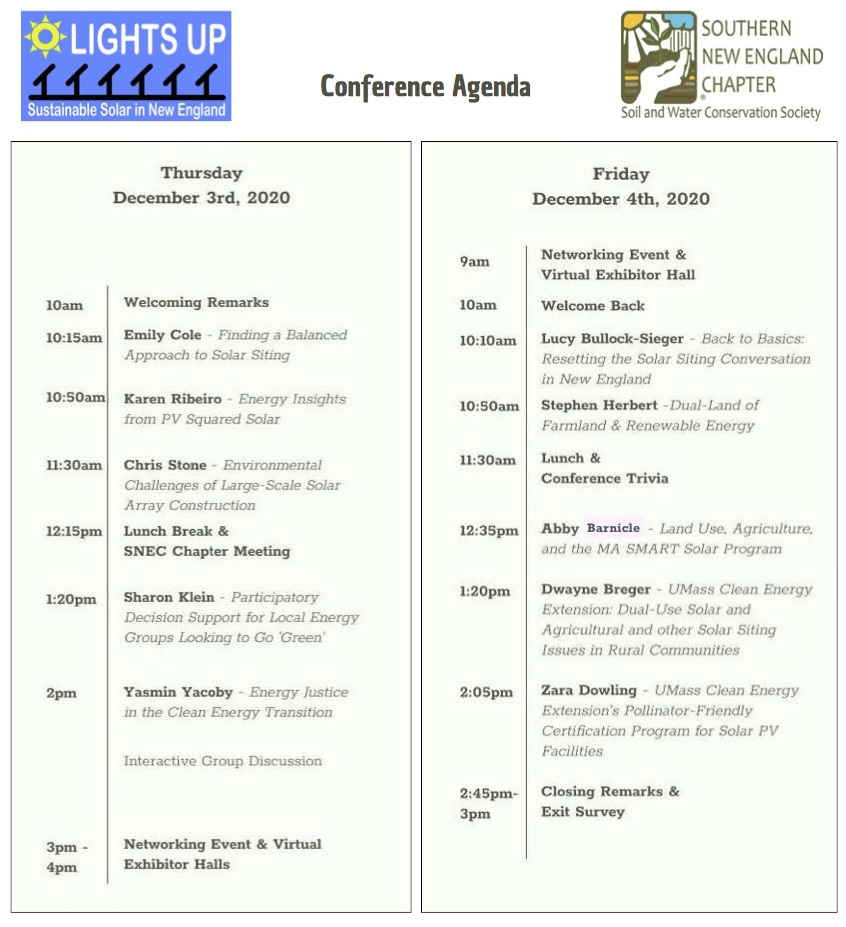
Our 2020 conference will shine a light on the role of sustainable solar energy in New England. We will discuss the current status of solar and how innovation and community involvement can be combined to expand the use of sustainable solar. Each day in this 2-day virtual event will have around 5-6 hours of content including time for social events!
(Login Information Redacted)
Our previous conferences have attracted a wide range of participants from the private and public sectors. Don’t miss out on this opportunity to network with these Registered Attendees.
We’ve expanding networking through discord. Our attendees have the option of interacting with other conference goers through the Lights Up discord server.
Visit with our exhibitors in two individual breakout sessions. Each exhibitor will have their own Zoom breakout room. You will be able to move around between rooms and network.


All-Points Technology Corp:
Helping to Harness the Power of the Sun

Riggs Distler:
Connections Your Customers Count On


Additional Supporters Include:
TRC | Stantec | Davison Environmental |POWER Engineers
Supreme Industries | Watkins Strategies – Public Involvement Specialists

Written by Soil and Water Conservation Society Southern New England Chapter on . Posted in Events, Winter. 1 Comment on 2019 – Going With the Flow: Stream Continuity


Registration open to the first 100 registrations – WE ARE SOLD OUT!
A light breakfast and Lunch are included!
Certificate of Attendances will be provided, upon request during registration.
$75 SWCS Members
$75 Government Staff
$100 Non-Members
$40 Students
Don’t miss the chance to network with these Registered Attendees
We are excited to announce the program’s following Guest Speakers! 

Scott Jackson, Extension Associate Professor at the University of Massachusetts Amherst Department of Environmental Conservation, presented “Assessing and Addressing Ecological Disruption and Transportation Vulnerability Associated with Road-Stream Crossings”.
Taylor M. Bell, RI Project Manager for the US Army Corps of Engineers New England District will be presenting “Quantifying Stream Function”.
James Turek, Restoration Ecologist of the National Oceanic and Atmospheric Administration (NOAA) Fisheries Restoration Center and stationed at the Northeast Fisheries Science Center Lab in Narragansett, Rhode Island, will present “NOAA’s Role and Experiences in Restoring Migratory Fish Passage and River Restoration in the Northeast”. (No reuse of these materials are allowed by others without the consent of the author and sources. Thank you.)

Christine Odiaga Assistant Project Manager of Friends of Herring River will provide an overview of the HERRING RIVER RESTORATION PROJECT, the largest wetland restoration project in the northeastern United States, “Full Stream Ahead!”
Tom Hennessey, is a Bridge Consultant at Contech Engineered Solutions LLC for MA, RI, and CT and will discuss “Open Bottom Structures for Fish Migration”, sharing local CT, MA, and RI projects recently completed.
Tayler Engel , lead GIS Analyst and UAS Pilot at ARE-AirShark will have a presentation on Environmental Monitoring and unmanned aircraft systems (UAS)/drones, “UAS LiDAR for Environmental Analysis”.
Tom Benjamin, Registered Landscape Architect (RLA), LEED-AP BD+C, of WELLNESSCAPES will have some great restoration projects while presenting “Bioengineered Waterway & Slope Stabilization Applied”.
Laura Wildman, Director of the New England Regional Office at Princeton Hydro, LLC, will present “Dam Removal; When Less is More”.
Steve Gephard, Supervising Fisheries Biologist, State of Connecticut- DEEP/Inland Fisheries Division of the Diadromous Fish and Habitat, Conservation, and Enhancement programs will present “Getting Migratory Fish Over the Myriad of Barriers in Connecticut”.


Written by Soil and Water Conservation Society Southern New England Chapter on . Posted in Events, Winter. 1 Comment on 2017 – Resiliency Planning
21 Feb: AirShark added as Exhibitor
PROGRAM | ATTENDEES | EXHIBITORS & SPONSORS
rev 17 Feb 2017 – includes agenda, speaker information, workshop/presentation descriptions and more
The SWCS Southern New England Chapter 2017 Winter Conference program will deliver 6 hours of professional development content. Conservation district and Government employees register at the Member rate; Student and Group Discounts are being offered.
Go to the PROGRAM page for the Agenda, descriptions of the Workshops & Presentations and Speaker biographies & contact information.
REGISTERED ATTENDEES as of 17 Feb
Certificates of Attendance will be provided. The agenda will be included to facilitate use for maintaining professional certifications. CT FORESTERS: the program has been approved for 2.0 Continuing Education Units for CT Certified Forest Practitioners.
A limited amount of exhibit space is available. Scroll down for more information. 3 tables available
Benefits of sponsorship range from website and program exposure for your company, to signage at the venue and prominent exhibit space for higher levels. Scroll down for information about sponsorship opportunities.
$140 includes 1 year SWCS & SNEC membership at the Conservationist level and conference registration at the member rate
* for first-time SWCS members
includes 6-foot table with one chair and registration for one person. Additional exhibitor staff: $50.
14 Feb: 3 tables still available
The Soil & Water Conservation Society (SWCS) is a nonprofit scientific and educational organization. The Southern New England Chapter (SNEC) was founded in 1946 to serve CT, MA and RI. SNEC is funded by event income, membership dues (<$500/year) and sponsorship; the annual Winter Conference is the SNEC’s primary source of revenue. Benefits of sponsorship range from website and program exposure for your company, to signage at the venue and prominent exhibit space for higher levels.

Eversource (NYSE: ES) transmits and delivers electricity and natural gas for approximately 3.7 million electric and natural gas customers in Connecticut, Massachusetts and New Hampshire. Eversource harnesses the commitment of its approximately 8,000 employees across three states to build a single, united company around the mission of delivering reliable energy and superior customer service. For more information, please visit our website (www.eversource.com) and follow us on Twitter (@EversourceCorp) and Facebook (facebook.com/EversourceEnergy).